Crosscurrents in the Data: Why Flexibility Matters in Core Plus
Vice President, Senior Client Portfolio Manager
×
x

Daniel P. Ryan
Vice President, Senior Client Portfolio Manager
Dan joined Weitz Investment Management in 2021. Prior to joining the
firm, he was a Senior Vice President with Amundi Smith Breeden-Amundi Pioneer
and prior to that was Vice President, Director of Institutional Sales at
Calamos Advisors. Dan has a bachelor's in economics and finance from the State
University of New York College at Buffalo.
dryan@weitzinvestments.com
630-362-6663

The economic narrative has shifted more than once in recent weeks.
The labor market surprised to the upside. Inflation moderated. Consumer activity softened. Housing weakened materially. Treasury yields adjusted in response to each release — recalibrating as markets absorbed new information.
Individually, none of these developments are extraordinary. Taken together, they highlight a more important reality: the macro backdrop is not moving in a straight line.
For fixed income investors, that matters.
Economic Crosscurrents: Strength and Strain Coexist
Labor Market Resilience
January's employment report showed 130,000 jobs added, well above expectations of 55,000. The unemployment rate registered 4.3%. A firm labor market reinforces the view that economic momentum remains intact and reduces urgency for immediate Federal Reserve easing.
Inflation Moderation
Consumer Price Index (CPI) rose 2.4% year over year and 0.2% month over month, with Core CPI at 2.5%. The trend suggests continued progress toward price stability, though not a definitive pivot. Moderating inflation keeps the possibility of eventual easing in view.
Emerging Consumer and Housing Pressure
Other areas of the economy show signs of strain:
- Consumer spending was flat relative to expectations for +0.4%.
- 9.6% of student loan balances are now 90+ days delinquent.
- Previously owned home sales fell 8.4% month over month to a four-year low.
The National Association of Realtors described conditions as a “new housing crisis,” citing affordability constraints and weakening confidence.
The takeaway is not that one narrative has prevailed. It is that multiple narratives are unfolding simultaneously.
An Environment of Reaction, Not Prediction
When employment remains firm, inflation trends lower and segments of the consumer economy weaken, the forward path of policy becomes increasingly conditional.
Will labor resilience delay rate cuts?
Will softer consumer trends accelerate disinflation?
Will housing weakness spill into broader growth?
The answers will likely evolve with the data.
In this type of environment, high-conviction macro forecasts can quickly become outdated. For fixed income investors, the emphasis shifts from prediction to preparation.
Portfolio construction must account for:
- Shifts in rate-cut expectations
- Volatility in term premiums
- Changes in credit spread compensation
- Rotations in relative value across sectors
Static allocations can become misaligned when the inputs are changing.
Flexibility in Practice
The sand chart below illustrates how allocations within our Core Plus Income Fund (WCPBX) have evolved over time. The shifts reflect changes across the full fixed income opportunity set.
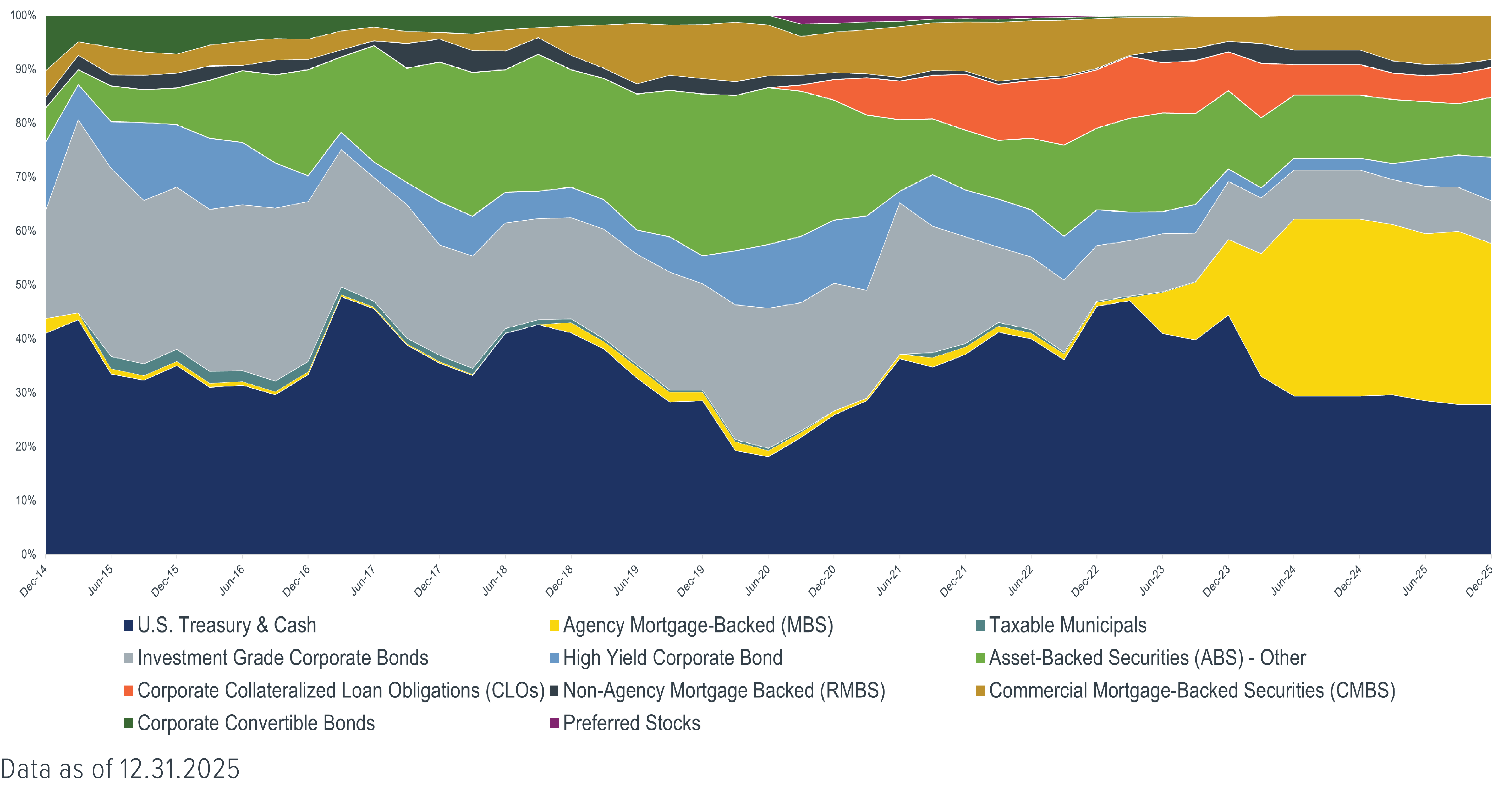
These adjustments are not driven by short-term forecasts, but by changes in relative value and, the compensation available for taking risk across the fixed income universe.
A flexible approach allows us to:
- Allocate capital where spreads offer attractive compensation for risk
- Adjust duration exposure as growth and inflation expectations evolve
- Diversify across sectors when dispersion creates opportunity
- Reduce exposure when valuations become less compelling
Importantly, flexibility also supports risk management. When markets concentrate risk in narrow segments of the benchmark, the ability to look beyond index constraints can help build a portfolio with more diversified sources of risk and return.
In our view, core fixed income should provide stability, but stability does not require rigidity. An adaptive structure allows the portfolio to evolve alongside the market environment rather than remaining anchored to static allocations.
What This Means for Fixed Income Investors
Today's backdrop is characterized by crosscurrents:
- A labor market that remains firm
- Inflation that continues to moderate
- Consumers exhibiting selective weakness
- A housing market under pressure
Any one of these forces could shape the next phase of the cycle. Or they may continue to offset one another, extending uncertainty.
Rather than anchoring portfolios to a single macro outcome, we believe flexibility — grounded in valuation discipline, broad diversification and active risk management — is essential. In an environment where the data shifts quickly and narratives overlap, the ability to adjust duration, credit exposure and sector positioning can help capture opportunities and manage risks that static allocations might overlook.
This philosophy underpins how we approach core fixed income today. In our view, a flexible, research-driven strategy that can navigate beyond benchmark constraints and across the fixed income universe positions investors to respond to evolving market conditions without being anchored to yesterday's narrative.
Learn More About WCPBX
/sitefiles/live/documents/literature-and-publications/Market Perspective/_2.13.26_Crosscurrents_CorePlus_DRyan.pdf
The opinions expressed are those of Weitz Investment Management and are not meant as investment advice or to predict or project the future performance of any investment product. The opinions are current through 2/13/2026, are subject to change at any time based on market and other current conditions, and no forecasts can be guaranteed. This commentary is being provided as a general source of information and is not intended as a recommendation to purchase, sell, or hold any specific security or to engage in any investment strategy. Investment decisions should always be made based on an investor's specific objectives, financial needs, risk tolerance and time horizon.
Holdings are subject to change and may not be representative of the Fund's current or future investments.
Consider these risks before investing: All investments involve risks, including possible loss of principal. Market risk includes political, regulatory, economic, social and health risks (including the risks presented by the spread of infectious diseases). Changing interest rates may have sudden and unpredictable effects in the markets and on the Fund's investments. The Fund may purchase lower-rated and unrated fixed-income securities, which involve an increased possibility that the issuers of these may not be able to make payments of interest and principal. See the Fund's prospectus for a further discussion of risks.