Yield Is Back. But Where Is It Coming From?
Vice President, Senior Client Portfolio Manager
×
x

Daniel P. Ryan
Vice President, Senior Client Portfolio Manager
Dan joined Weitz Investment Management in 2021. Prior to joining the
firm, he was a Senior Vice President with Amundi Smith Breeden-Amundi Pioneer
and prior to that was Vice President, Director of Institutional Sales at
Calamos Advisors. Dan has a bachelor's in economics and finance from the State
University of New York College at Buffalo.
dryan@weitzinvestments.com
630-362-6663

The return of yield has changed the conversation around fixed income. After years of near-zero interest rates, investors can once again earn meaningful income across much of the bond market. Even high-quality, short-maturity securities offer yields that would have been difficult to find only a few years ago.
That is an important improvement. But an attractive headline yield does not tell the whole story.
A bond's yield reflects more than one source of compensation. Part comes from the base rate—the yield available from a comparable U.S. Treasury. The rest comes from spread: the additional yield investors receive for accepting credit, liquidity and other risks.
That distinction matters. When base rates are high, investors may be able to earn a meaningful level of income before taking additional risk. The question, then, is not simply how much a bond yields, but how much investors are being paid for each additional risk they assume.
Looking beneath
the headline yield
Investment-grade corporate credit provides a useful example. Corporate bonds currently offer yields that are attractive in absolute terms. Yet much of that yield is not coming from corporate credit spreads. It is coming from the same higher base rates available in the Treasury market.
The chart below shows option-adjusted spread as a percentage of yield to worst for the Bloomberg U.S. Corporate Bond Index. In simple terms, it shows how much of the index's yield comes from compensation for taking credit risk rather than from the underlying base rate.
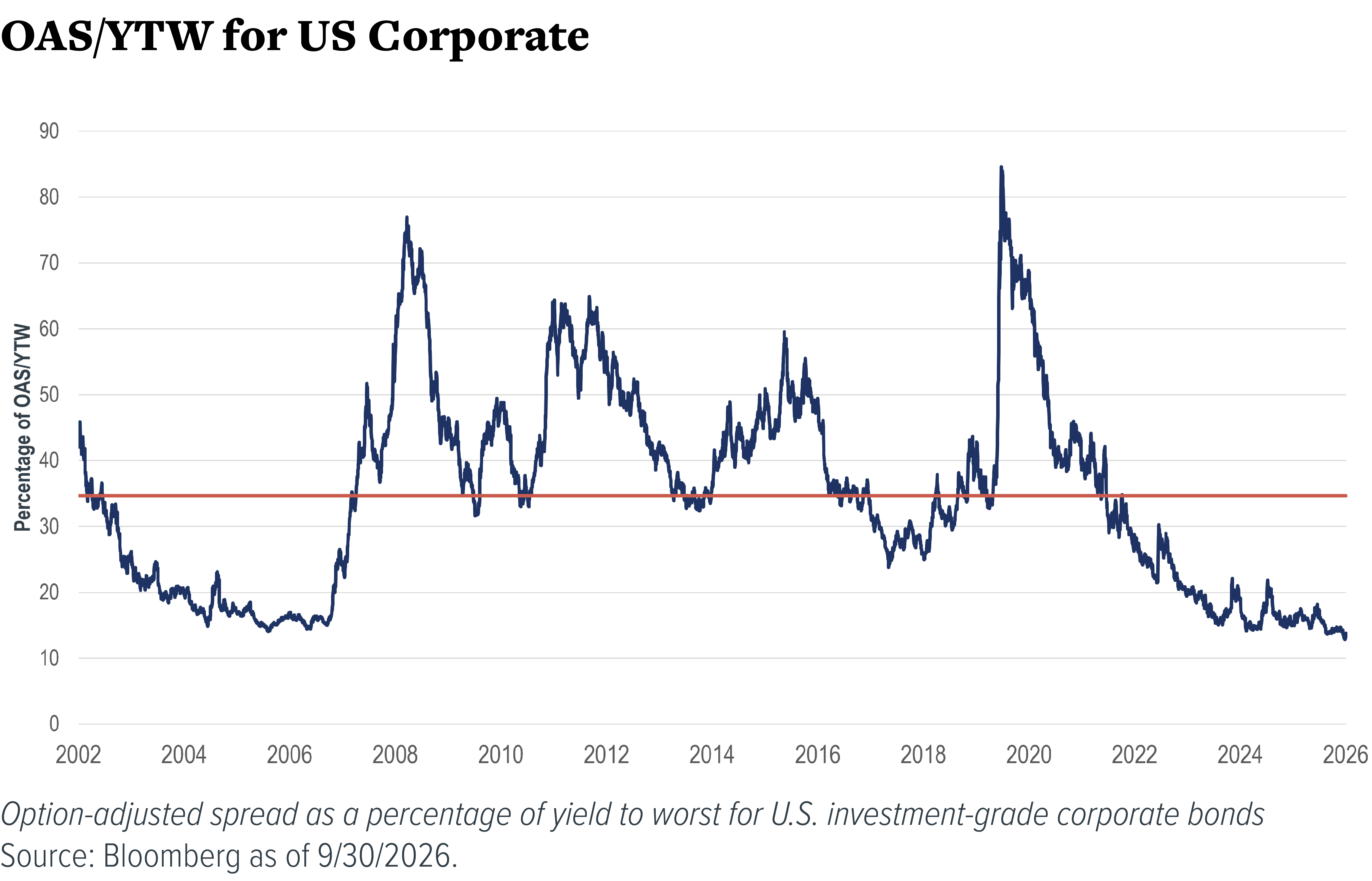
Over the full period shown, spread represented approximately 34-35% of the index's yield to worst on average. Today, that figure is roughly 13-14%. Put differently, more than 85% of the yield available in investment-grade corporate bonds is coming from the base rate rather than incremental compensation for corporate credit risk.
Attractive all-in yields may help explain why demand for corporate bonds has remained strong even as spreads have stayed near historically tight levels. But today's headline yields can make the relatively modest contribution from credit spread less apparent. The yield is real—and attractive—but the source of that yield matters.
The all-in yield
can mask the tradeoff
Tight spreads do not mean corporate bonds are broadly unattractive, nor do they tell us when spreads will widen. Strong corporate fundamentals, resilient economic growth and persistent investor demand can support tight valuations for extended periods.
But spreads are the portion of yield intended to compensate investors for taking corporate credit risk. When spreads are tight, investors receive less incremental compensation for assuming that risk. The possibility of deteriorating fundamentals, downgrades, reduced liquidity or spread widening has not disappeared simply because all-in yields are attractive.
History provides perspective. During the Global Financial Crisis and the onset of the COVID-19 pandemic, spreads represented a much larger share of corporate yields as markets demanded more compensation for uncertainty and potential loss. Today's environment sits near the opposite end of that spectrum: absolute yields are elevated, but the incremental premium for owning corporate credit is comparatively modest.
The distinction is especially relevant when Treasuries themselves offer meaningful income. U.S. government securities remain exposed to interest-rate volatility, but they do not carry the same corporate credit risk. If a large portion of a corporate bond's yield can be earned from the base rate alone, the remaining spread must be evaluated against the additional risk required to earn it.
Applying the same
lens to a portfolio
The same question—what risks am I taking, and what am I being paid for them?—can be applied at the portfolio level.
Many investors access fixed income through strategies tied closely to the Bloomberg U.S. Aggregate Bond Index. The Agg remains an important representation of the investment-grade bond market, but it is constructed according to eligibility rules and the amount of debt outstanding. Its composition does not change based on the relative attractiveness of the risks represented by each sector.
The index also carries a predetermined mix of Treasury, agency mortgage-backed and investment-grade corporate exposure. Each sector introduces a different set of risks. Fixed-income securities generally carry interest-rate risk, while individual sectors introduce additional risks. Agency mortgages, for example, add prepayment and extension risk, while corporate bonds add credit and liquidity risk. A benchmark owns that combination because of how it is constructed, not because each risk offers the same level of compensation or is equally attractive at a given point in the market cycle.
Flexibility begins
with choosing the risk
Today's higher-rate environment gives investors more flexibility than they had when yields were near zero. Generating income does not necessarily require taking additional credit risk or extending duration indiscriminately. A portfolio can begin with the income available from base rates and add other risks selectively when the potential compensation appears sufficient.
That may include maintaining shorter-duration exposure when interest-rate volatility is elevated, favoring one part of the credit market over another when dispersion creates better opportunities, or looking beyond traditional corporate bonds to securitized sectors where spread may compensate investors for liquidity, structural complexity or market inefficiency rather than corporate default risk alone.
The objective is not to eliminate risk. Risk is inseparable from investing. The objective is to understand which risks a portfolio owns, how those risks may behave in different environments and whether investors are being adequately compensated for taking them.
That kind of selectivity requires flexibility. As relative value changes, portfolio exposures can adjust accordingly—across duration, sectors and individual securities. Just as importantly, flexibility allows investors to be patient when the available compensation appears insufficient and to respond when better opportunities emerge.
Getting paid for the risk
For years, the challenge in fixed income was finding enough yield. Today's starting point is different. Higher rates have restored meaningful income to bonds, allowing investors to be more selective about where they take additional risk.
An attractive headline yield is only part of the equation. The more useful question is what risks produce that yield—and whether investors are being adequately compensated for taking them.
/sitefiles/live/documents/literature-and-publications/Market Perspective/10.2026_Yield is Back_DRyan.pdf
The opinions expressed are those of Weitz Investment Management and are not meant as investment advice or to predict or project the future performance of any investment product. The opinions are current through 10/8/2026, are subject to change at any time based on market and other current conditions, and no forecasts can be guaranteed. This commentary is being provided as a general source of information and is not intended as a recommendation to purchase, sell, or hold any specific security or to engage in any investment strategy. Investment decisions should always be made based on an investor's specific objectives, financial needs, risk tolerance and time horizon.
Definitions: Option Adjusted Spread (OAS) is a “spread” compares the interest rate on a particular bond against a “base line” bond (typically a U.S. Treasury bond). When a bond issuer (or bondholder) has the option to exercise a right (for example, if the issuer can call a bond before its stated maturity date), then the “Option Adjusted Spread” takes into account the possibility that this option might be exercised—so a bond›s Option Adjusted Spread may be more (or less) than its regular spread. Yield to Worst (YTW) is the lowest potential yield that can be received on a bond portfolio without the issuers actually defaulting. YTW references in this article are to U.S. investment-grade corporate bonds, as represented by the Bloomberg U.S. Corporate Bond Index.