Understanding Private Credit Beyond the Headlines
Vice President, Senior Client Portfolio Manager
×
x

Daniel P. Ryan
Vice President, Senior Client Portfolio Manager
Dan joined Weitz Investment Management in 2021. Prior to joining the
firm, he was a Senior Vice President with Amundi Smith Breeden-Amundi Pioneer
and prior to that was Vice President, Director of Institutional Sales at
Calamos Advisors. Dan has a bachelor's in economics and finance from the State
University of New York College at Buffalo.
dryan@weitzinvestments.com
630-362-6663

Recent headlines surrounding private credit have focused on the share price declines of several publicly traded direct lending platforms and concerns about exposures to certain sectors, such as software companies facing valuation pressure.
While these stories have attracted attention, they often reflect a narrow segment of a much broader market.
In practice, fixed income markets span a wide range of borrowers and structures. Public markets include instruments such as U.S. Treasuries, agency mortgage-backed securities, corporate bonds, and syndicated loans. Private credit markets, by contrast, often involve loans negotiated directly between lenders and privately owned middle-market companies—often businesses that are too large for traditional small-business lending yet too small to access public debt markets.
The term “private credit” is increasingly used as a catch-all label, often focused on large direct lending platforms or publicly traded lenders. In reality, the private credit universe is far more diverse, encompassing a wide range of borrowers, structures, and underwriting approaches.
For investors, the more important questions are not simply whether an investment is labeled “private credit,” but how the underlying loans are underwritten, how the structure is designed, and how the investment fits within a diversified portfolio.
Headlines Often Focus on Lenders, Not Borrowers
Many of the recent headlines have centered on the equity performance of publicly traded private credit managers or direct lending platforms. While these companies are visible because their shares trade in public markets, they represent only one segment of the broader private credit ecosystem.
Importantly, headlines about the market value of publicly traded lenders should not be confused with the financial health of the thousands of businesses that borrow through private credit markets.
Those borrowers span industries across the middle-market economy, including manufacturing, healthcare, logistics, distribution, and business services. While some borrowers have experienced challenges, their performance is typically tied to company fundamentals and cash flows rather than the daily trading prices of lenders' equity shares.
Understanding this distinction is important when evaluating the broader health of private credit markets.
Not All Private Credit Is the Same
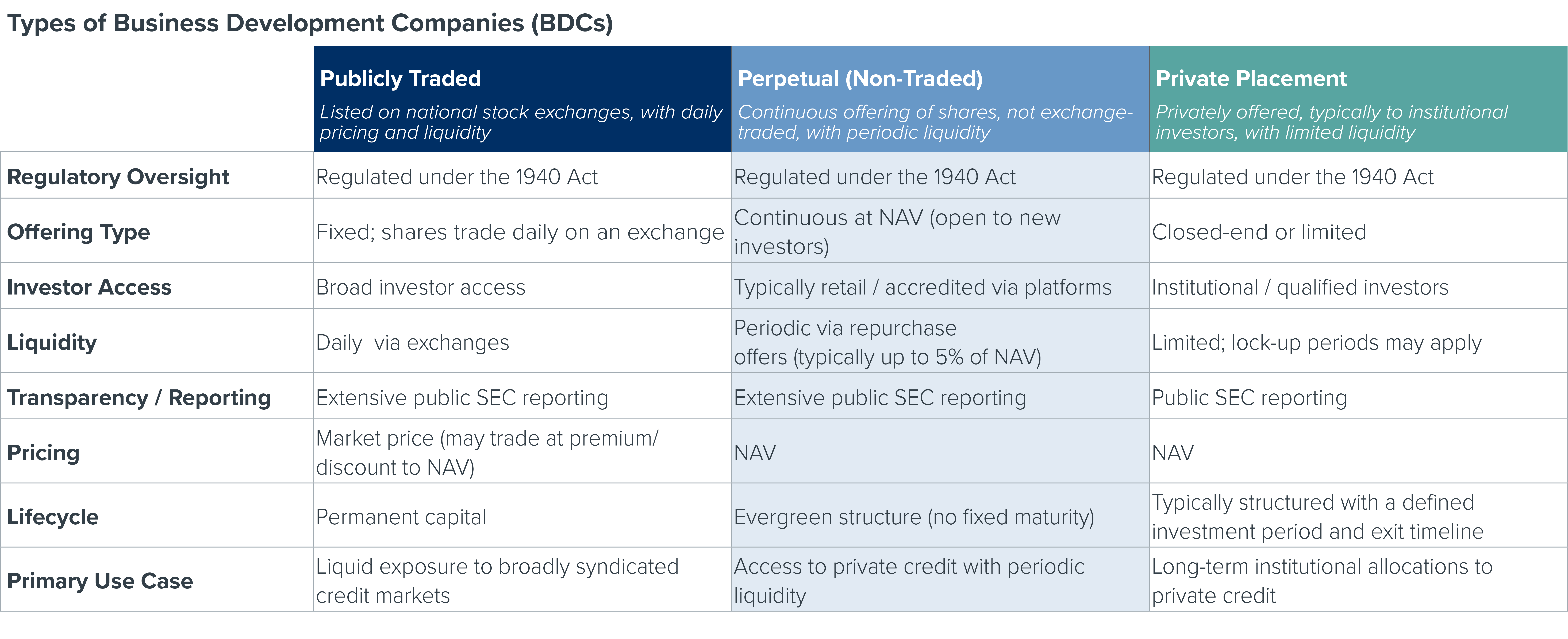
A significant portion of the recent discussion has centered on Business Development Companies (BDCs), which are publicly registered investment vehicles that invest in private credit. As with any sector, BDCs vary widely in underwriting discipline, portfolio composition, leverage, and management quality.
Research from several large banks and broker-dealers, including JPMorgan, has suggested that some private loans used as collateral for bank financing could face valuation pressure.
Importantly, these developments have not resulted in widespread margin calls or requirements to post additional collateral. The more likely outcome is that banks may apply somewhat tighter lending standards for the financing that some BDCs use.
That distinction matters because changes in financing conditions are very different from deterioration in the underlying loans or the companies borrowing the capital.
“Gating” Is a Feature, Not a Bug
Another headline theme has involved large asset managers such as BlackRock or Blue Owl limiting investor withdrawals in certain private credit vehicles, including non-traded (perpetual) BDCs and interval-style funds. Much of the recent attention has centered on these non-traded BDC structures, where redemption limits have become a focal point for investors.
These vehicles are not listed on an exchange and are typically structured as perpetual, or evergreen, funds with periodic liquidity rather than daily liquidity.
While this may sound alarming when viewed through the lens of daily-liquidity vehicles such as '40 Act mutual funds or ETFs, redemption limits are an intentional structural feature of many private credit strategies. Because the underlying loans are less liquid than publicly traded securities, these vehicles typically allow only periodic redemptions, often through repurchase offers.
These mechanisms help prevent forced selling during periods of market volatility and allow investors to capture the illiquidity premium associated with lending in less liquid markets. At the same time, these structures limit investors' ability to redeem capital on demand. Investors in these vehicles typically accept these liquidity constraints in exchange for the potential return opportunities associated with less liquid investments.
In other words, gating in these structures is often a stabilizing feature of the design rather than a sign of market stress.
Private Credit Is a Large and Diverse Market
Private credit today is far larger and more diverse than headlines often suggest. Estimates place the global private credit market at approximately $2.5 trillion or more, making it comparable in size to—or larger than—the U.S. high-yield and leveraged loan markets.¹
Importantly, publicly traded BDCs represent only a portion of that universe. BDC assets total approximately $475 billion, a fraction of the broader private credit market.²
In the U.S., a significant portion of private credit lending is directed toward privately owned businesses within the middle-market segment of the economy—firms that are often too large for traditional small-business lending yet too small to access public debt markets.
Following the Global Financial Crisis, regulatory changes increased capital and regulatory requirements for banks. While these reforms strengthened the banking system, they also reduced banks' willingness to lend to many smaller and middle-market companies. Private credit lenders increasingly stepped in to help fill that financing gap, providing capital to businesses that remain an important part of the broader economy.
The U.S. middle market—generally defined as companies with annual revenues between $10 million and $1 billion—includes roughly 200,000 businesses that collectively generate about one-third of U.S. private-sector GDP and employ approximately 48 million people.³
These companies operate across industries ranging from manufacturing and healthcare to logistics, distribution, and business services. While middle-market statistics include both privately held and publicly listed companies, much of that lending is directed toward privately owned businesses within this segment.
Investors gain exposure to this segment of the economy through a variety of credit structures, each with its own risk, return, and liquidity characteristics.
Diversification Within Credit Markets
Within this broader landscape, we evaluate opportunities across a range of credit structures rather than focusing on any single segment. Different structures offer different combinations of diversification, liquidity, and return potential, and thoughtful portfolio construction involves assessing where risk and return are most appropriately aligned.
One area where we have found opportunities is within middle-market collateralized loan obligations (CLOs). These structures pool loans to dozens or even hundreds of companies and distribute the cash flows across different tranches of securities.
For investors, this structure can provide:
- Diversification across many underlying borrowers
- Exposure to multiple industries and credit sponsors
- Structural protections embedded within the CLO framework
- The ability to invest at different levels of the capital structure depending on risk tolerance
Because these pools contain loans to many companies across industries, investors can gain exposure to a broad segment of the middle-market economy rather than relying on the performance of any single borrower.
In addition, diversification can extend beyond individual loans to include exposure across multiple credit sponsors and lending platforms. Rather than relying on a single platform, allocating across a range of lending platforms can provide broader exposure to underlying borrowers and reduce concentration risk. In practice, this approach can involve lending across a broad set of lending platforms, further increasing diversification across underlying loans and industries.
Because many middle-market loans are directly originated, overlap across lending platforms tends to be lower than in broadly syndicated loan markets, which can further enhance diversification.
In many cases, these investments sit higher in the capital structure than equity investments in private credit vehicles. For example, BDCs often finance their portfolios through a combination of equity and debt, including secured financing and CLO structures. In these structures, debt investors are senior to the BDC equity, meaning they have a higher claim on cash flows and collateral.
Evaluating these structures requires extensive credit analysis and structural modeling, often comparable to or more involved than analyzing a single corporate bond issuer.
In mutual funds and ETFs, regulatory requirements around liquidity and daily pricing also influence portfolio construction. These considerations tend to limit the types and amounts of less liquid private credit investments that can be held, which is why portfolios often emphasize more liquid segments of the market
“
When we invest in a CLO, we’re gaining exposure to a broad pool of underlying loans. That means dozens or even hundreds of different businesses across industries—not a single borrower or sector.
- Nolan Anderson
Co-Head of Fixed Income
Portfolio Construction Matters
In a diversified fixed-income strategy offered through mutual funds or ETFs, private credit investments represent only one component of the overall portfolio.
These portfolios may also include allocations to sectors such as U.S. Treasuries, agency mortgage-backed securities, asset-backed securities, and corporate bonds, each serving different roles within the portfolio.
Maintaining exposure to highly liquid securities helps ensure that mutual funds and ETFs can meet investor redemptions and distributions during periods of market stress. At the same time, credit allocations that may be less liquid—including private credit—can provide additional income and diversification when attractive opportunities arise.
Ultimately, effective portfolio construction depends not only on balancing diversification and liquidity across fixed-income sectors, but also on the quality of the underlying lending decisions.
“
Liquidity matters in a '40 Act fund structure. Holdings such as Treasuries and agency mortgages provide stability and flexibility, allowing us to meet investor flows while allocating capital where we see the most attractive opportunities.
- Nolan Anderson
Co-Head of Fixed Income
Credit Investing Is Ultimately About Lending
At its core, credit investing involves making lending decisions. Each investment represents capital provided to a borrower, and the central question is whether the compensation offered appropriately reflects the risks involved.
Our investment process focuses on evaluating opportunities across a wide range of fixed-income markets and allocating capital where we believe the most attractive risk-adjusted relative value exists.
This includes analyzing borrower fundamentals, evaluating capital structures, and modeling how investments may perform across different economic environments.
The team also uses structural modeling tools and ongoing issuer engagement to maintain visibility into the underlying collateral and cash flows of the securities we own. In many cases, this includes reviewing detailed loan-level information and maintaining regular dialogue with credit sponsors and management teams.
This disciplined research process helps ensure that lending decisions are grounded in a deep understanding of both the borrower and the structure of each investment.
“
At the end of the day, credit investing is about lending. Our job is to understand the borrower, evaluate the structure of the investment, and determine whether the compensation offered adequately reflects the risks involved.
- Nolan Anderson
Co-Head of Fixed Income
When Headlines Create Opportunity
Because the private credit universe includes many different structures and borrowers, broad headline-driven reactions can sometimes create opportunities for disciplined investors.
When valuations decline without meaningful deterioration in the underlying businesses or their ability to repay loans, credit markets can present attractive entry points.
As in many areas of credit investing, the key distinction lies between headline risk and fundamental risk.
1 Bank for International Settlements (BIS), March 2025,
2 Apollo Global Management, August 2025
3 National Center for the Middle Market, Middle Market Indicator, Year-End 2025
/sitefiles/live/documents/literature-and-publications/Market Perspective/_3.26_AML_Understanding_PC_DR.pdf
The opinions expressed are those of Weitz Investment Management and are not meant as investment advice or to predict or project the future performance of any investment product. The opinions are current through 3/16/2026, are subject to change at any time based on market and other current conditions, and no forecasts can be guaranteed. This commentary is being provided as a general source of information and is not intended as a recommendation to purchase, sell, or hold any specific security or to engage in any investment strategy. Investment decisions should always be made based on an investor's specific objectives, financial needs, risk tolerance and time horizon.