Looking Under the Hood of High Yield
Vice President, Senior Client Portfolio Manager
×
x

Daniel P. Ryan
Vice President, Senior Client Portfolio Manager
Dan joined Weitz Investment Management in 2021. Prior to joining the
firm, he was a Senior Vice President with Amundi Smith Breeden-Amundi Pioneer
and prior to that was Vice President, Director of Institutional Sales at
Calamos Advisors. Dan has a bachelor's in economics and finance from the State
University of New York College at Buffalo.
dryan@weitzinvestments.com
630-362-6663

High-yield bonds have rewarded investors over much of the past several years. Strong economic growth, resilient corporate fundamentals and ample market liquidity helped compress credit spreads and support attractive returns across much of the below investment-grade market.
Today, however, the market appears to be sending a more nuanced message. Broad high-yield spreads remain well below the levels associated with major market stress, but beneath the surface differences in how credit risk is being priced are becoming more pronounced.
High-yield bonds are debt securities rated below investment grade—generally BB+ or lower— by one or more major credit-rating agencies. They typically offer higher yields than investmentgrade bonds to compensate investors for greater credit and default risk.
The differences in how stronger and weaker credits are being priced have increased. As the credit cycle evolves, the more useful question may be less about whether an investor owns high yield and more about the securities underlying that exposure and the risks they carry.
Credit Quality Is
Driving Greater Dispersion
Periods of broad market dislocation—such as the pandemic shock in 2020 and the inflation-driven repricing in 2022—pushed spreads wider across nearly every segment of high yield. The pattern in 2026 has been different. Dispersion—the degree to which spread levels vary across credits—has increased, with much of the widening occurring among CCC-rated issuers.
As of July 31, 2026, BB-rated spreads were 173 basis points, only 4 basis points wider year to date. B-rated spreads were 304 basis points, up just 3 basis points. CCC-rated spreads, by contrast, reached 1,034 basis points—149 basis points wider year to date.
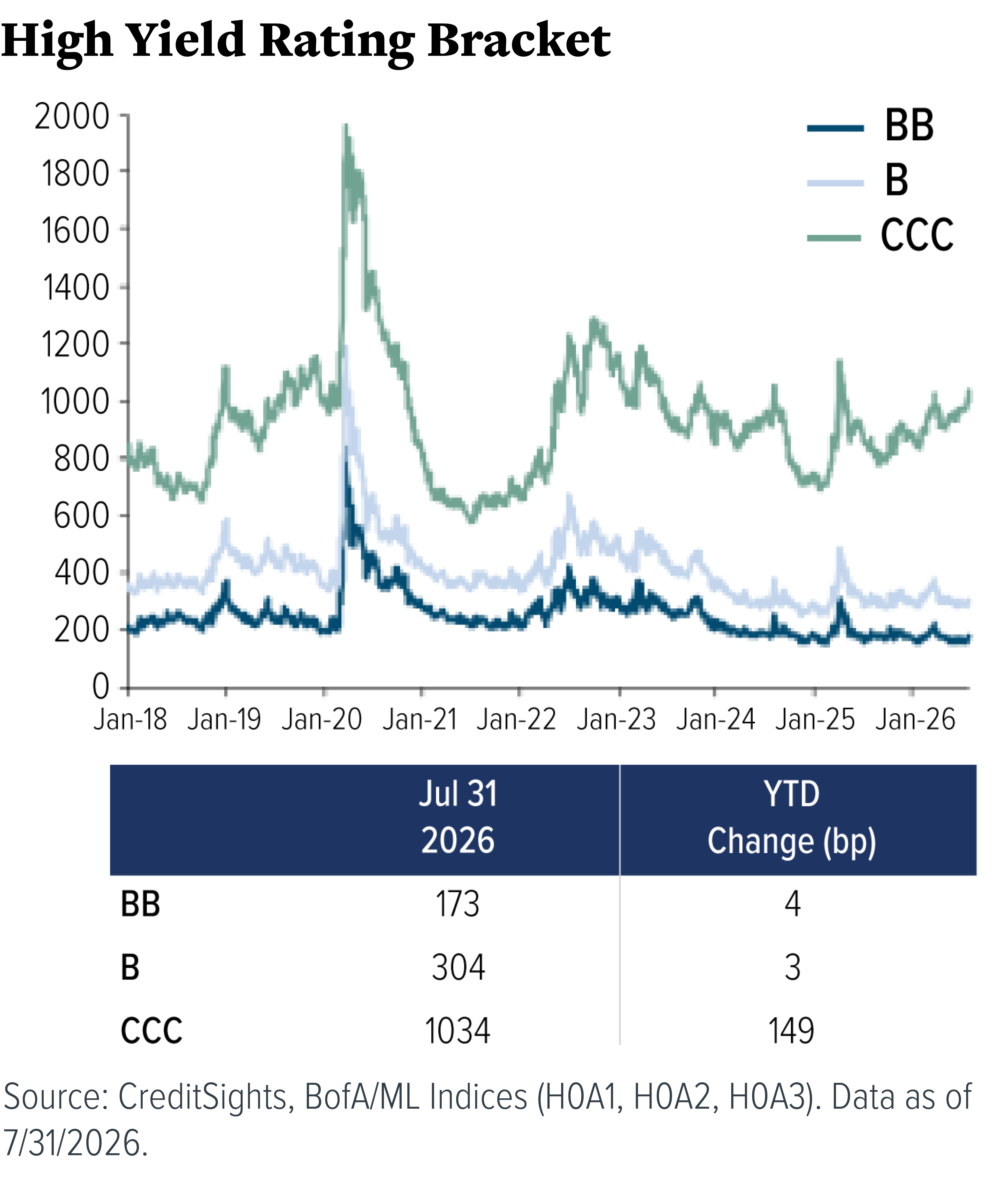
This widening gap suggests the market is demanding more compensation from issuers facing greater refinancing, liquidity or operating challenges, while pricing comparatively resilient conditions for higher-quality borrowers.
Understanding Credit Spreads and Ratings
Credit spread is the additional yield a bond offers over a comparable term U.S. Treasury security. Investors
generally demand wider spreads as compensation for taking greater credit risk.
Credit ratings are assessments of an issuer’s ability to meet its debt obligations. Ratings below BBB- are
generally considered below investment grade, or high yield. Within the high-yield range, BB-rated securities
are generally considered higher credit quality than B-rated securities, which in turn are generally considered
higher credit quality than CCC-rated securities.
High Yield Is
Not a Single Asset Class
“High yield” describes a level of credit quality rather than a single type of fixed-income security. Below-investment-grade exposure can exist across different parts of the fixed-income market, and issuers can have materially different balance sheets, business risks, capital structures and access to financing.
A BB-rated issuer just below investment grade may have a very different risk profile from a highly leveraged CCC-rated company confronting refinancing uncertainty. Two portfolios can therefore offer similar yields while relying on very different combinations of credit quality, sector exposure, issuer concentration and downside risk.
Broader diversification across issuers, industries and maturity dates can help reduce the impact that a single credit problem, sector-specific setback or concentrated refinancing period may have on the overall portfolio.
That is why headline yield and trailing return can be incomplete measures. Neither necessarily reveals the types and concentration of risk within a portfolio.
Dispersion Can Create
Opportunity—and Risk
Greater dispersion is not inherently negative. It can create a richer opportunity set for investors willing to analyze individual issuers. As dispersion increases, balance-sheet strength, free cash flow, capital structure, refinancing needs and creditor protections become more consequential.
The same environment also raises the cost of being wrong. A high coupon may reflect an attractive mispricing, but it may also signal elevated default or recovery risk. Distinguishing between the two requires more than a rating or a yield screen.
Looking Beyond Yield
and Historical Returns
Recent performance can naturally attract attention, but trailing returns reflect market conditions that have already occurred. As spreads, yields and business conditions change, yesterday's return may say little about the compensation available for taking credit risk today.
A more useful evaluation begins with the portfolio itself:
- Where does the exposure sit across BB, B and CCC-rated issuers?
- How diversified are the underlying issuers, industries and maturity dates?
- What portion of the income reflects Treasury yields, credit spreads or idiosyncratic risk?
- How could refinancing needs, weaker cash flow or a slower economy affect individual borrowers?
- Does the incremental yield appear sufficient for the credit and liquidity risk being assumed?
Credit Exposure Is Not
the Same as a Market Call
Portfolio exposure does not always reflect a broad forecast for the high-yield market. In a bottom-up process, individual securities may be selected because their expected returns appear to compensate for their specific risks, even when other areas of the high-yield market appear less attractive.
As issuer-level opportunities change, a portfolio's high-yield exposure may rise or fall. Those changes can reflect security selection rather than a broad market call. It is another reason two portfolios with similar high-yield allocations can carry materially different risks.
Bottom Line
The widening gap between BB, B and CCC spreads reflects greater dispersion in how the market is pricing credit risk.
As credit cycles evolve, broad labels become less informative. Understanding the sources of a portfolio's yield—including credit quality, concentration, refinancing risk and security-level fundamentals—can be just as important as the yield itself.
The goal is not to avoid high yield. It is to identify where the compensation for risk appears adequate and where a seemingly attractive yield may offer too little margin for error.
/sitefiles/live/documents/literature-and-publications/Market Perspective/8.2026_HighYield_AML_DRyan.pdf
The opinions expressed are those of Weitz Investment Management and are not meant as investment advice or to predict or project the future performance of any investment product. The opinions are current through 8/17/2026, are subject to change at any time based on market and other current conditions, and no forecasts can be guaranteed. This commentary is being provided as a general source of information and is not intended as a recommendation to purchase, sell, or hold any specific security or to engage in any investment strategy. Investment decisions should always be made based on an investor's specific objectives, financial needs, risk tolerance and time horizon.