Vice President, Co-Head of Fixed Income, Portfolio Manager
×
x

Tom Carney, CFA®
Vice President, Co-Head of Fixed Income, Portfolio Manager
Multisector Bond ETF (Since November 2025)
Core Plus Bond ETF (Since August 2025)
Core Plus Income Fund (Since July 2014)
Short Duration Income Fund (Since January 1996)
Ultra Short Government Fund (Since January 1996)
Investment industry experience since 1982
Tom joined Weitz Investment Management in 1995
as an equity trader. He was promoted to
co-portfolio manager in 1996 and to portfolio manager in 1999. Prior
to joining the firm, Tom held several positions at Chiles, Heider & Co.,
Inc. Previously, he was a municipal securities professional with Smith
Barney. Tom has a bachelor's in finance from the University of Nebraska
Omaha.
Vice President, Co-Head of Fixed Income, Portfolio Manager
×
x

Nolan P. Anderson
Vice President, Co-Head of Fixed Income, Portfolio Manager
Multisector Bond ETF(Since November 2025)
Core Plus Bond ETF(Since August 2025)
Core Plus Income Fund (Since July 2014)
Short Duration Income Fund (Since July 2017)
Ultra Short Government Fund (Since December 2016)
Conservative Allocation Fund (Since July 2021)
Investment industry experience since 2004
Nolan joined Weitz Investment Management in 2011 as a fixed income research analyst. In 2014, he was promoted to portfolio manager. Prior to joining the firm, Nolan performed financial modeling and due diligence on leveraged buyout transactions for Wells Fargo Bank. Previously, he worked for WoodmenLife as a commercial real estate mortgage analyst. Nolan has a bachelor's in real estate and land use economics, and an MBA from the University of Nebraska Omaha.

The fixed-income landscape entered the second quarter
defined by geopolitical and macroeconomic tension surrounding the conflict in
the Middle East and its attendant effects on domestic growth and inflation.
Depending on the day, the U.S. action in Iran resembled two steps forward and
one step back—or the reverse. A chorus from the 1970s band The Clash seemed to
describe the U.S. deliberations in the Middle East — “Should I stay, or should
I go now? If I go, there will be trouble—and if I stay, it will be double.” A tenuous truce in April ultimately led to a
peace agreement (memorandum of understanding) in mid-June, providing at least a
temporary easing of tensions. The price of oil, a key input to inflationary
pressures, made a round trip from the low $70s per barrel at the onset of the
conflict in February to more than $100 at its peak, before returning to the low
$70s by quarter end. If the current oil price holds, it should help reduce
inflationary pressures, particularly at the gas pump.
The Federal Reserve
The Federal Reserve also took center stage during the
quarter. While no changes were made to the federal funds rate, new Fed Chairman
Kevin Warsh was confirmed by the narrowest Senate margin in history. Despite
concerns that Warsh would be a puppet of the current president, he demonstrated
both his independence and that of the Federal Reserve at his first Fed meeting
in June. He reinforced his hawkish stance on inflation while announcing five
new task forces to evaluate everything from Fed communication frameworks (no
more forward guidance) to balance sheet management and artificial intelligence.
The market's response, coupled with recent inflation readings, was to pivot
from expectations of further rate cuts in 2026 toward potential rate hikes.
Given that the Fed's 2% inflation target has been exceeded for 64 consecutive
months, this shift seems more than reasonable.
Despite all the drama of the last 90 days, it was a rather
ho-hum quarter for most fixed-income markets. Total returns were middling as
coupon income was partially offset by price depreciation resulting from rising
U.S. Treasury yields, particularly among bonds maturing in less than 10 years.
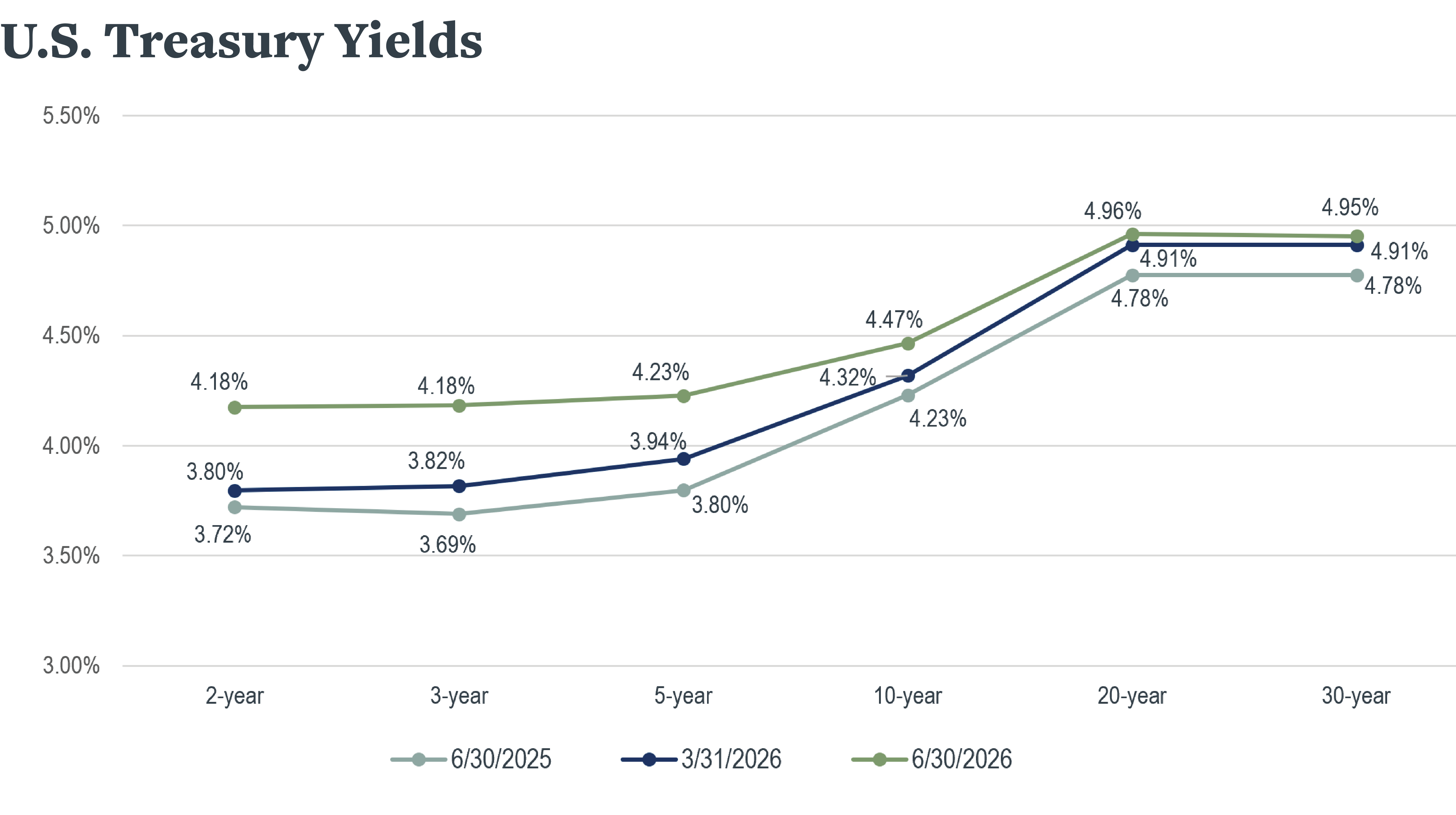
The chart below provides a view of U.S. Treasury yields over
time (quarter-over-quarter and year-over-year) across the yield curve. The
yield curve experienced a bear flattener, with short-term interest rates rising
faster than long-term rates. For example, the spread between 2- and 10-year
Treasuries declined from 52 to 29 basis points during the quarter as
expectations for additional short-term rate cuts gave way to the possibility of
rate increases. Longer-term interest rates (20- and 30-year Treasuries) climbed
above 5% during the quarter before receding below that level and ultimately
ending the quarter only modestly higher than where they began.
Credit Markets
Corporate bonds were characterized by record-breaking new
issuance, with June reaching an all-time monthly record of $187 billion,
headlined by SpaceX's $25 billion inaugural bond offering. Credit spreads
remained remarkably tight, and new issues were met by massive investor demand,
with June deals heavily oversubscribed. Issuance was driven by refinancing
needs, debt-funded merger and acquisition (M&A) activity, and extensive
capital spending for artificial intelligence (AI) infrastructure.
Despite geopolitical shocks in the Middle East and
interest-rate volatility triggered by a hawkish Federal Reserve, corporate risk
premiums remained near multi-decade lows.
- Investment-Grade (IG) Resilience: The ICE BofA U.S. Corporate Bond Index finished the quarter with an option-adjusted spread of 76 basis points, down from 90 basis points on March 31.
- High Yield (HY) Outperformance: High yield bonds continued to show strength, with the ICE BofA U.S. High Yield Index spread declining from 328 basis points on March 31 to 275 basis points at quarter end.
Despite broad credit spreads hovering near historically low
levels, dispersion continued to widen among lower-rated corporate issuers.
Lower-tier BBB and sub-investment-grade technology companies continue to face
credit pressure through wider spreads due to the enormous capital requirements
of funding ongoing AI expansion or fears of outright displacement from AI.
The “all-in yield” magnet remains a powerful force. Spreads
stayed tight because corporate bond buyers were less focused on incremental
credit premiums and more attracted to the absolute returns, as all-in corporate
yields remained above 5%.
Securitized assets delivered solid performance during the
second quarter of 2026, supported by generally solid consumer and commercial
credit fundamentals, strong investor demand and attractive income relative to
similarly rated corporate bonds. Credit spreads remained generally tight across
most sectors, although modest volatility created selective opportunities in
lower-rated and more specialized segments.
Agency mortgage-backed securities (MBS) benefited from
declining interest-rate volatility, while non-agency residential
mortgage-backed securities (RMBS) continued to outperform as home prices
remained stable and mortgage credit quality stayed strong. Asset-backed
securities (ABS), particularly those backed by auto loans, equipment, and
consumer receivables, generated favorable returns amid healthy issuance and
robust demand. Commercial mortgage-backed securities (CMBS) also posted
positive results, although performance remained differentiated by property
type, with industrial, multifamily, and lodging sectors outperforming
office-related exposures. Collateralized loan obligations (CLOs) continued to
attract investors seeking floating-rate income, although market participants
became increasingly selective as issuance remained elevated and dispersion
widened across underlying loan quality.
Overall, securitized credit remained one of the
stronger-performing segments of the fixed income market during the quarter,
offering attractive carry and resilient credit performance despite a backdrop
of higher interest rates and ongoing macroeconomic uncertainty.
While large portions of the credit markets remain at or near
historically low spread levels, there will invariably be select areas of
investment opportunity, particularly given our ability to seek out the most
attractive risk-adjusted opportunities both within and outside benchmark
categories.
Outlook
Across our fixed income strategies, we continue to emphasize
liquidity (e.g., Treasuries and agency MBS), higher-quality securities and
attractive income generation. We believe this approach positions us well as we
begin the second half of 2026 and will allow us to lean in as liquidity
providers if and when more favorable risk/reward opportunities present
themselves.
We also believe our ability to cast a wider net across the
fixed-income landscape—particularly across securitized products with structural
enhancements and where we believe income opportunities remain attractive
relative to bond indexes—continues to be a meaningful advantage in today's
environment. Please see our Quarterly Commentaries for further details around
investment activity in the second quarter.
We are thankful for the trust and partnership so many have
placed in our firm and our investment process. We are also especially thankful
for our home country as we commemorate its 250th birthday. We owe a debt of
gratitude to those whose vision of liberty, hard work, self-governance and
sacrifice has propelled the “American experiment” for two and a half centuries.
Despite its many warts, the United States remains a beacon of freedom for the
world and an engine of global finance. While remaining clear-eyed in our
investment process, we will continue to heed one of Warren Buffett's
foundational philosophies—to “never bet against America”—as well as Benjamin
Franklin's famous response when asked whether the Constitutional Convention had
created a republic or a monarchy: “A republic, if you can keep it.”
/sitefiles/live/documents/literature-and-publications/FI_Insights/2Q26_FII_HoldingLine.pdf
The opinions expressed are those of Weitz Investment Management and are not meant as investment advice or to predict or project the future performance of any investment product. The opinions are current through 7/7/2026, they are subject to change at any time based on market and other current conditions, and no forecasts can be guaranteed. This commentary is being provided as a general source of information and is not intended as a recommendation to purchase, sell, or hold any specific security or to engage in any investment strategy. Investment decisions should always be made based on an investor's specific objectives, financial needs, risk tolerance and time horizon.